
Commercial dishwasher repair in Minneapolis and St. Paul
On-site repair of door-type, conveyor and undercounter dishwashers and booster heaters in Minneapolis, St. Paul and nearby suburbs.
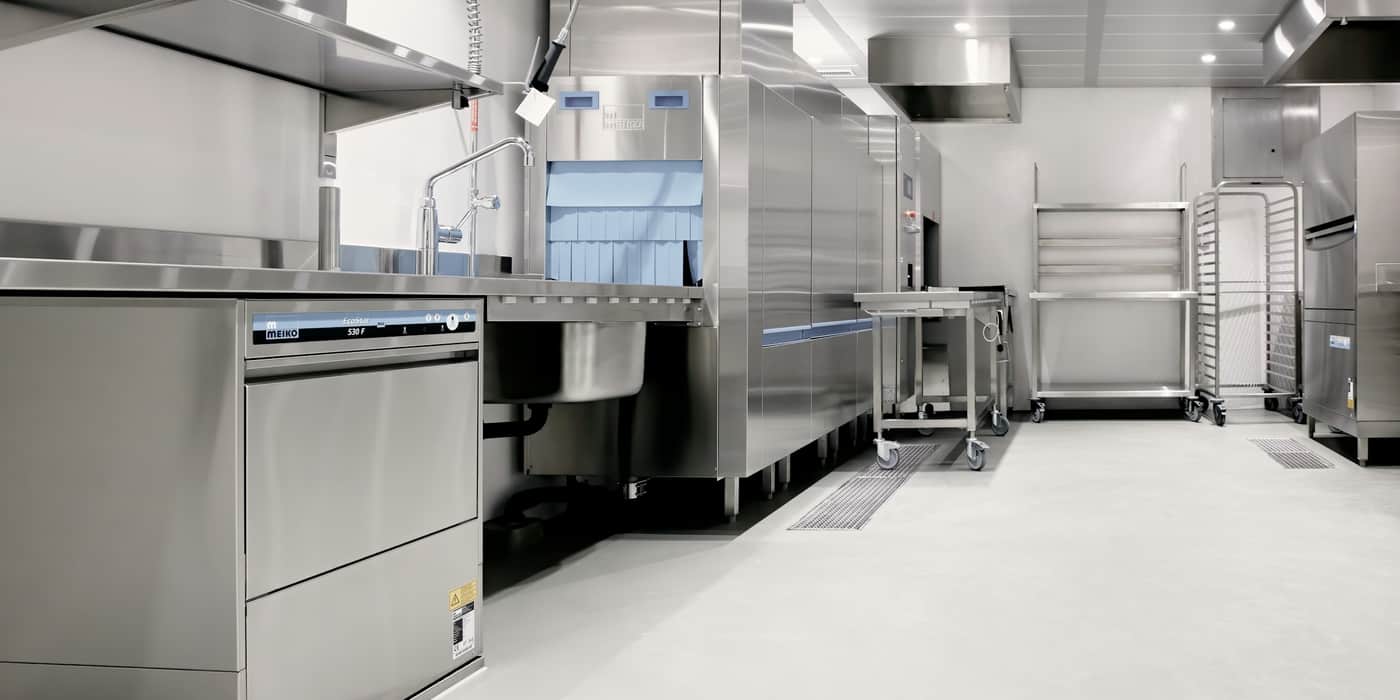
Why is my commercial dishwasher not cleaning or sanitizing dishes?
Dirty or unsanitized dishes usually trace to low wash or final rinse temperature, a clogged wash arm or scrap tray, weak rinse pressure, or an empty chemical feed. A technician checks the tank and rinse temperatures against the machine's data plate, then the pump, nozzles and chemical injection in that order.
How a commercial dishwasher fails and gets repaired
A dish machine is the one appliance in the kitchen that cannot be bypassed. When it stops, plates, pans and cooking tools stop cycling back to the line, and a full-service room runs out of clean plates and sauté pans long before it runs out of food on the shelves, so the clock starts the moment the last rack is used. We repair door-type, conveyor and undercounter machines on site, plus the booster heaters that feed them hot rinse water.
Most dish machine calls come down to three systems: heat, water movement and chemistry. A tank element that has scaled over, a wash pump seal that weeps, or a sanitizer pump that has lost its prime each leave dishes that look wrong or fail a health inspector's test. If the machine is also draining slowly, our guide to a commercial dishwasher that is not draining covers that failure in depth, and the schedule for deliming and routine care covers prevention.
Commercial dishwasher complaints, causes and corrections
| Complaint | Likely cause | Correction |
|---|---|---|
| Dishes come out gritty or with food still on them | Wash arms or arm nozzles are plugged with food, the scrap tray is missing or packed, or the wash pump is moving less water than it should because of a worn impeller. Low tank temperature also prevents the detergent from working. | We pull the arms and clear the nozzles, check the pump pressure and the tank temperature, and replace a worn impeller or seal if flow has dropped. |
| Glasses and plates have a white film | Hard-water scale on spray nozzles and heating elements, or a rinse-aid dose that is too high or too low. Scaled elements also lose heating output. | We descale the tank, elements and arms and check the rinse additive feed. A water softener or filter that has gone exhausted is flagged as the root cause when we see it. |
| Final rinse never reaches sanitizing temperature | A failed booster element, a tripped high-limit, a weak incoming hot water supply, or a rinse thermometer reading wrong. A rinse solenoid that does not open fully lowers pressure, which also changes temperature at the manifold. | We measure the temperature at the manifold during a rinse, test the booster element and thermostat, and confirm incoming hot water supply before replacing parts. |
| Machine fills slowly, overfills or will not stop filling | A clogged fill strainer or weak supply pressure causes slow filling. A stuck fill solenoid, a failed float switch or a sensing probe coated in scale causes overfilling. | We clean the strainer, test the solenoid coil and valve body, and clean or replace the level control that tells the machine when the tank is full. |
| Water stays in the tank after the cycle | A failed drain solenoid or actuator, a stuck drain stopper, or a plugged standpipe. In some machines a worn drain linkage keeps the plug from lifting. | We test the drain actuator, free or replace the stopper and linkage, and clear the line past the machine. |
| Wash pump hums, trips the breaker or leaks at the base | A seized impeller, a failed pump seal letting water into the motor, or a motor winding that has overheated. Leaks at the shaft usually come before motor failure. | We test the motor and capacitor and replace the seal or the pump assembly, depending on whether water has reached the motor windings. |
| Machine will not start a cycle | A door or hood interlock switch that is misaligned or worn, a tripped overload, a failed control board or a tank that never reached its fill level. | We check the interlock and level switches first, since they are the most common stop, then test the control circuits. |
| Conveyor stops or racks jam inside the machine | A worn slip clutch, a broken pawl, a conveyor motor that has lost torque, or a rack hung on a curtain or a bent guide. | We inspect the drive, clutch and pawl bars, correct the rack path and replace the worn drive component. |
| Detergent or sanitizer not being delivered | A peristaltic pump tube that has worn flat, an empty or air-locked supply line, a clogged injection fitting, or a faulty conductivity probe. | We replace the pump tube and fittings, prime the line and verify the dose with test strips or a titration kit. |
Before you call about a commercial dishwasher
- Confirm the breaker and any disconnect near the machine are on, and that the door or hood closes fully onto its switch.
- Look at the scrap tray, strainer basket and wash arms for food, and rinse them clean before you restart a cycle.
- Check that the hot water supply valves to the machine and the booster are open, and read the temperature gauges on the front panel after a full fill.
- Look at the detergent, rinse aid and sanitizer containers and confirm the pickup tubes are in liquid and not kinked.
- Note any code or light on the display and write it down. Do not open the electrical compartment or reset a booster that keeps tripping.
Stop at gas valves, 208, 240 or 480 volt wiring, sealed refrigerant circuits, steam under pressure and anything live. Those are a call.
How we diagnose a commercial dishwasher
Run a full cycle and watch it
We observe fill, wash, drain and rinse with the machine loaded as it would be on the line, noting what the display shows and which stage fails.
Verify the temperatures that matter
We read the wash tank and the final rinse temperature at the manifold, and compare them with the data plate. High-temperature machines depend on that rinse reading, so a gauge on the front is not enough on its own.
Check rinse pressure and flow
A gauge on the rinse line tells us whether the pressure regulator, strainer and solenoid are passing enough water. Pressure that drifts out of range affects both coverage and temperature.
Test the electrical and control path
We test elements, thermostats, high-limits, contactors and interlocks with the power controlled, and use the circuit's behavior to separate a failed part from a failed board.
Test chemical delivery and finish
We confirm the detergent and sanitizer doses, replace worn pump tubing, then run a loaded cycle again before we hand the machine back.
Parts that fail most on commercial dishwashers
- Wash pump seal and impeller
- The seal keeps water out of the motor, and a worn impeller drops wash pressure without any alarm.
- Heating element
- Tank and booster elements scale over in hard water and can open-circuit, which stops the heating of wash and rinse water.
- Drain and fill solenoids
- Coils burn out and valve seats pick up debris, causing slow fills, leaks or water left in the tank.
- Door or hood interlock switch
- A small switch tells the control the door is closed, and it is a common reason a cycle will not start.
- Rinse solenoid and pressure regulator
- These set the rinse flow and pressure at the manifold, and scale or debris upsets both.
- Wash and rinse arm nozzles
- Nozzles clog with food and scale, leaving dead spots on the rack.
- Thermostat and high-limit
- These regulate and protect the heating circuit, and a high-limit trips when elements overheat from scale.
- Peristaltic chemical pump tube
- The rubber tube squeezed by the pump rotor wears flat and stops delivering chemical without any visible leak.
Commercial dishwashers we repair, by type
- Door-type (hood) machines
A hood or door lifts for a rack that is slid in and out by hand. The door switch, hood counterbalance, curtain and wash arm bearings see the most wear, and most use a single wash tank, fed by a booster heater mounted under or beside the machine.
- Conveyor machines
Racks ride a pawl or belt conveyor through wash, rinse and sometimes a pre-wash zone. Drive motors, pawl bars, slip clutches, tank heat and the long runs of rinse nozzle manifolds are what we are usually chasing.
- Undercounter machines
A small front-loading cabinet used in bars, cafes and small kitchens. The entire wash and rinse system sits in a compact cabinet, so one scaled element or a failed drain solenoid shows up immediately in the result.
- High-temperature machines
These sanitize with a final rinse of hot water, so they depend on a booster heater or an internal heater to reach the required temperature at the manifold. Most no-sanitize calls on these machines are heat problems.
- Low-temperature chemical machines
Sanitizing happens with a chemical injected into the final rinse, not by heat. The chemical pump, its tubing and the supply line are the repair items, and test strips tell us quickly whether the dose is correct.
- Booster heaters
A separate electric or steam-fed tank that lifts incoming hot water to the sanitizing rinse temperature. Elements, thermostats, high-limit switches and relief valves fail here, and a failed booster makes a perfectly good machine appear broken.
What decides the cost
- Which part failed matters most: a drain solenoid and a wash pump motor are very different repairs, and a scaled element is a cleaning problem before it is a parts problem.
- A machine run for months with scale can carry secondary damage to elements, solenoids and thermostats, so a repair that starts with one part sometimes grows once the tank is open.
- Age and model drive parts availability. Common door-type and undercounter parts are easy to source, and older conveyor machines can need a longer parts lead time.
- Access matters on conveyor machines and tight undercounter installs where the pump, drain or wiring cannot be reached without pulling the machine out.
- Steam-fed boosters add a steam valve and trap to the work, which an electric booster does not have.
Repair or replace the commercial dishwasher?
A well-kept dish machine can run for many years, and most of its failures are bolt-on parts: pumps, solenoids, switches, elements. Repair stops making sense when the tank is leaking from a corroded weld, when the control board and several major components fail close together, or when parts for a discontinued model are hard to find. A machine that still cannot reach its rated rinse temperature after a new booster element and thermostat points to a problem inside the machine, such as an undersized hot water supply, and that is worth weighing against a newer unit. Our repair-or-replace guide walks through the questions we ask on that call.
Commercial dishwashers by brand
Related to commercial dishwasher repair
Maintenance for this equipment
Related repairs
Where it matters most
Where we repair commercial dishwashers
- Commercial dishwasher repair in Ellsworth, WI
- Commercial dishwasher repair in Farmington, MN
- Commercial dishwasher repair in Forest Lake, MN
- Commercial dishwasher repair in Fridley, MN
- Commercial dishwasher repair in Golden Valley, MN
- Commercial dishwasher repair in Hastings, MN
- Commercial dishwasher repair in Hudson, WI
- Commercial dishwasher repair in Inver Grove Heights, MN
- Commercial dishwasher repair in Lakeville, MN
- Commercial dishwasher repair in Maple Grove, MN
- Commercial dishwasher repair in Maplewood, MN
- Commercial dishwasher repair in Minneapolis, MN
Other warewashing repairs
Questions about commercial dishwashers
What temperature does a high-temperature dishwasher have to reach?
Under the Food Code as Minnesota adopts it, the final hot water rinse at the manifold must be at least 180°F, or 165°F for a stationary-rack single-temperature machine, and no more than 194°F. We read the manifold temperature during a rinse, because the front gauge can be off.
Does rinse pressure matter on a commercial dishwasher?
Yes, Minnesota's rule requires a commercial dishwasher's fresh hot water rinse to run within the flow pressure range on the machine's data plate, and never below 5 psi or above 30 psi, measured just before or after the rinse control valve. Too little pressure leaves ware uncovered, so we check the regulator and strainer on every no-sanitize call.
What does it mean when the booster heater keeps tripping its high-limit?
A high-limit opens when the booster overheats, and the usual causes are an element coated in scale, a thermostat that no longer shuts the heat off, or a tank running with too little water in it. The reset is a symptom, so we test the element, thermostat and relief valve before resetting anything.
Can a booster heater be repaired, or does it need replacing?
A dishwasher booster heater can usually be repaired, because most failures are an element, thermostat, high-limit or relief valve, and each is replaceable. A tank that has corroded through or leaks at a weld is where replacing the whole booster makes more sense than repairing it, and a steam-fed booster adds its steam valve and trap to the check.
Why does my conveyor machine keep stopping with racks inside?
The slip clutch on the drive is meant to slip when a rack jams, so a stop usually means something is blocking the rack path or the clutch has worn. We check the pawl bars, curtains and guides, then the drive motor torque.
How do I know whether my machine is high-temperature or chemical?
A high-temperature machine has a booster or a rinse-heating element and a rinse temperature gauge, and its data plate lists minimum wash and rinse temperatures. A low-temperature machine has a sanitizer injection pump and a supply tank of chemical instead.