
Stero dishwasher repair in the Twin Cities
On-site Stero dishwasher repair in Minneapolis, Saint Paul and nearby: SD3 door-type, SUn undercounter and ER Series rack conveyors.
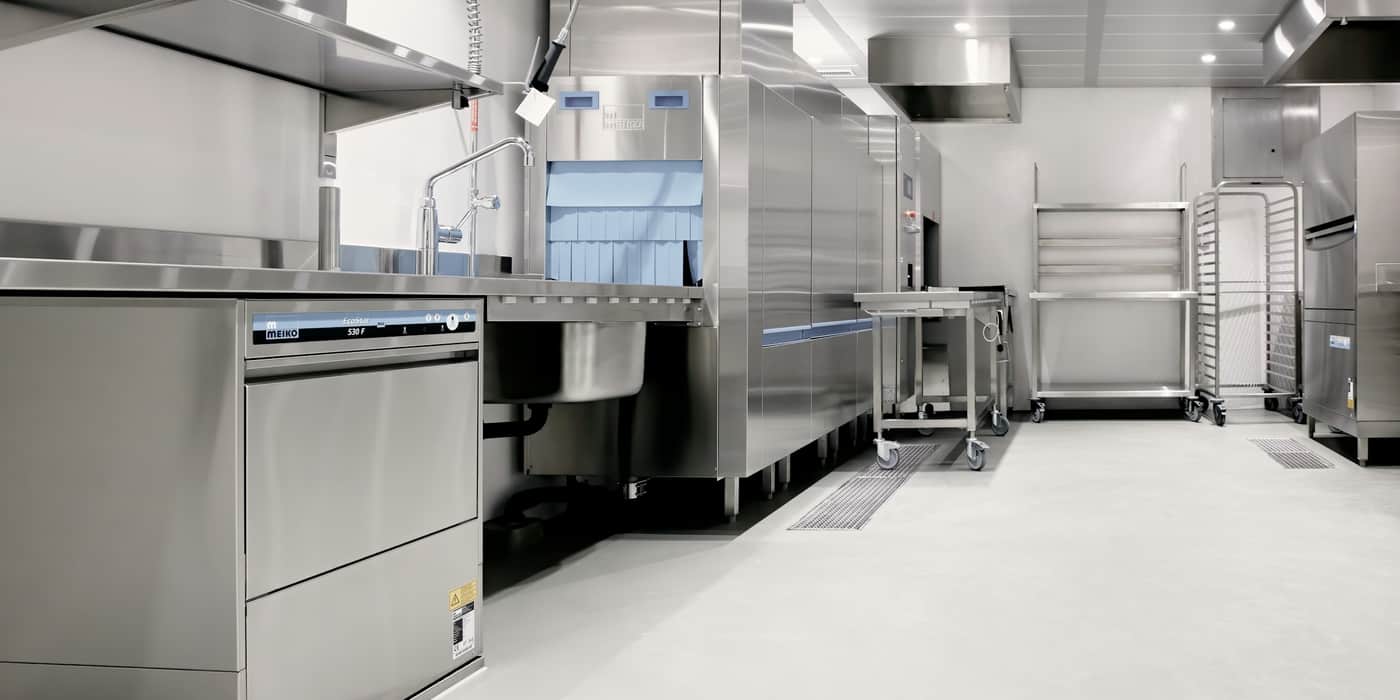
What fails first on a Stero dishwasher?
On Stero door-type and undercounter machines the first suspects are the booster heater and its high-limit, the water-level sensors, a worn drain seal and lime-clogged wash or rinse arms. On ER Series rack conveyors, look at the pawl bar and rack ladders, the table limit switch, clogged spray manifolds and the tank heat.
Stero dishwashers
Stero describes itself on its own site as a member of the ITW Food Equipment Group, part of Illinois Tool Works, and lists its address in Lancaster, Pennsylvania. Its catalog is warewashing only: door-type machines, undercounters, rack conveyors, flight-type conveyors, pot and pan washers and glasswashers. That puts it in the same corporate family as Hobart, and the current Stero undercounter service manual makes the link practical: it sends special tools and the drain body kit through Hobart parts.
In Twin Cities kitchens a Stero is usually the machine behind a hotel banquet line, a hospital or senior-living dish room, a school cafeteria or a college dining hall, with an undercounter SUn in a smaller restaurant or bar. What makes the repair specific is how much of the diagnosis sits in the machine's own display. The undercounter shows numbered fault codes, the SD3 shows EE when the booster never reaches temperature, and the ER Series is a pawl-driven conveyor with its own limit switch and shutdown timer. Our commercial dishwasher repair page covers the general side.
Reading the plate on Stero dishwasher
On the SD3 the machine data plate is on the bottom of the front panel and carries the serial number. On an ER Series conveyor it is on the front or side of the main electrical control panel. Have the model, such as SD3, SUnH, SUnL or ER66S, the serial number, the voltage and whether tank heat is electric or steam, plus any display code, ready when you call.
Stero SD3 door-type dishwashers
Equipment guide
Seen on this line: EE on the display after the first fill / Wash tank will not hold water, worn drain O-ring / Rinse temperature low, line strainer or lime in the rinse system / Wash arms not turning, strainer pan or bucket out of place
The SD3 is built to run in one of two modes. The display shows SH or SP for hot-water sanitizing and SC for chemical sanitizing, and the manual warns against running chemical mode without a properly installed, NSF-certified sanitizer feeder. The pump motor is rated 2 horsepower with thermal overload protection. The fill line has an atmospheric vacuum breaker, and a booster-equipped machine expects at least 110°F water into the booster to reach the 180°F final rinse. Below that the control stretches the wash time until the booster catches up. The manual lists EE on the display when the booster did not reach temperature within 8 minutes after the first fill, and says that may be a booster heater failure. It also names a worn or torn drain O-ring and a drain obstruction as reasons the wash tank will not hold water.
Stero SUn undercounter dishwashers
Equipment guide
Seen on this line: Code 22, low rinse temperature on three cycles / Code 30, booster heat-up time exceeded at startup / FIL showing, low water at the start of a wash / Drain or fill errors from a kinked hose or clogged strainer
The SUn comes as the SUnH, a high-temperature machine with a 5.5 kW sump heater and a 6.5 kW electric booster for a 180°F rinse, and the SUnL, a chemical-sanitizing machine with a 2.0 kW heater and 120°F wash and rinse. Both have a standard 2-minute cycle, an optional extended cycle set at 240 seconds at the factory, and use 0.84 gallons per rack. The service manual works from pressure-level sensors in the wash tank and the booster, a temperature probe, a rinse thermistor, a rinse pump, detergent and rinse-aid pumps and a USB port that exports the error list. Deliming is run from the control with the Delime button. Because the level sensors decide fill and drain, a kinked drain hose or a clogged pump strainer produces fault codes before it produces a visible leak.
Stero ER Series rack conveyors
Equipment guide
Seen on this line: Racks stall because the table limit switch is up / Pump motor starts, then stops, with clogged manifolds / Tank will not come up to temperature on steam heat / Final rinse sprayers plugged and rinse temperature low
The ER Series covers the ER44, ER54, ER64, ER66S, ER76S, ER76SC, ER86S, ER94S and ER94SC. Racks are moved by a pawl bar that pulls them through stationary upper and lower spray manifolds, then past the fresh-water final rinse. Tanks heat by electric element or steam, and the manual wants 180 to 195°F at the final rinse with about 20 psi at the rinse. Its operator troubleshooting table points to clogged spray manifolds, a table limit switch left in the up position, broken or worn rungs on the dish rack ladders and an incorrect shutdown timer when racks will not convey or the machine stops after a few minutes. A tank that will not heat is a tripped breaker, the tank heat switch off or, on steam machines, a closed steam supply or return valve before it is an element.
Stero fault codes by equipment
| Equipment | Code | Meaning |
|---|---|---|
| Commercial Dishwasher Repair | 22 | Low rinse temperature on SUn undercounters: the rinse stayed below setpoint on three consecutive cycles. It clears when the rinse reaches setpoint. |
| Commercial Dishwasher Repair | 30 | Booster heat-up time exceeded at startup on SUn undercounters. The manual points to a tripped high-limit or a heating element fault if it repeats. |
| Commercial Dishwasher Repair | FIL | Low water level at the start of a wash cycle on SUn undercounters. The tank refills and heats, and the cycle then resumes. |
| Commercial Dishwasher Repair | 25 | Internal communication error on SUn undercounters. |
| Commercial Dishwasher Repair | EE | On the SD3 door-type: the booster did not reach temperature within 8 minutes after the initial fill. |
Sourcing parts for Stero dishwasher
The Stero undercounter service manual lists drain body kits, door shims and manifold nuts as special items bought through Hobart parts, so parts for the SUn run through the ITW family catalog. Boosters, sensors and heating elements are matched by model and the voltage on the data plate, and the SUnH and SUnL do not share a heater or booster. Older Stero models such as the SD1 and SDRA are listed on the maker's site as discontinued, and parts work for them depends on what the model number identifies.
Stero next to Hobart and Jackson
More warewashing brands
Questions about Stero equipment
What does EE mean on a Stero SD3 dishwasher?
The SD3 manual says EE appears when the booster did not reach temperature within 8 minutes after the initial fill. It suggests turning the machine off, waiting a few seconds and turning it back on, and notes the cause may be a booster heater failure. Cold incoming water below 110°F also stretches the cycle.
Why does my Stero undercounter show code 22?
Code 22 means the rinse temperature stayed below setpoint on three consecutive cycles. On a high-temperature SUnH that points at the booster heater, the rinse thermistor or the temperature probe, or at incoming water too cold for the booster to recover. The code clears once a rinse meets setpoint.
Is a Stero the same company as Hobart?
Both belong to Illinois Tool Works. Stero's site lists it under the ITW Food Equipment Group, and the Stero undercounter service manual routes its special tools and drain body kit through Hobart parts. The machines themselves are separate designs with their own models and manuals.
Why will my Stero rack conveyor not move racks?
The ER Series manual lists a table limit switch left in the up position, broken or worn dish rack ladder rungs and clogged spray manifolds among the causes. The pawl bar pulls racks through, so a stalled rack stops everything behind it. Check that the table limit switch is not left up, then call about the drive.
How often should a Stero SD3 be delimed?
The SD3 manual says to delime when deposits are visible inside or outside the machine, and at a minimum once a month. The control walks the operator through it, showing ADD DELIME and then flashing DELIME while the pump runs. Hard-water scale is also what clogs wash arms and rinse nozzles.