
Restaurant and commercial kitchen equipment we repair
Every machine in a commercial kitchen fails in its own way, so each one here gets its own page. Pick the equipment below and you will find its symptoms, the parts that wear out, how a technician diagnoses it and what moves the cost.
If you are not sure where to start, the commercial kitchen equipment repair page covers problems that cross equipment, such as power, water quality and ventilation heat. If something is down right now, the emergency repair page tells you what to do in the first ten minutes.
All repair happens at your business. We give you a diagnosis and a written price to approve before any work starts.
Whole kitchen 1
- Commercial Kitchen Equipment Repair
A single independent service company can repair the whole commercial kitchen line: walk-in and reach-in refrigeration, ice machines, ovens, fryers, ranges, dish machines, hood fans and make-up air, mixers, slicers and coffee equipment. We repair it on site at your business, give you a written price to approve first, and answer emergency calls 24/7.
Refrigeration 10
- Commercial Refrigeration Repair
Commercial refrigeration usually stops holding temperature because of restricted airflow, not a dead compressor: a dirty condenser coil, a failed condenser or evaporator fan, a frozen evaporator from a defrost fault, or a leaking door gasket. A technician reads the pressures and temperatures first, then decides whether the sealed system is involved.
- Walk-In Cooler Repair
A walk-in cooler that drifts warm is usually short on airflow or heat rejection. The usual causes are an iced or dirty evaporator coil, a dead evaporator fan, a condensing unit that cannot shed heat, a stuck defrost, or a door that leaks warm humid air. The box temperature alone does not say which one it is.
- Walk-In Freezer Repair
A walk-in freezer warms up when the coil can no longer pull heat out of the box. The most common causes are a failed defrost heater or termination switch that lets the coil freeze solid, a dead evaporator fan, a leaking door that feeds in moist air, or a compressor that is not pumping.
- Reach-In Refrigerator Repair
A reach-in that is warm but running usually has a dirty condenser coil, a failed evaporator or condenser fan, a worn door gasket or a bad temperature control. A unit that hums and does not run points to a start capacitor, relay or compressor. Each has a different fix, so the symptoms matter.
- Commercial Freezer Repair
A freezer that runs warm or builds heavy frost usually has a failed defrost heater, defrost sensor or timer, a stopped evaporator fan, a blocked condensate drain, or a dirty condenser. Frost on the back wall points at defrost. A hot compressor with no cold air points at airflow or the start components.
- Refrigerated Prep Table Repair
A prep table that cannot hold 41°F in the pans usually has a dirty condenser, a failing evaporator or condenser fan, a worn lid or door gasket, or a plugged drain. The rail is the weak point because it is cooled by air that has to travel. Product above the fill line or a lid left open makes it worse.
- Bar Cooler & Kegerator Repair
A bar cooler that runs warm usually has a dirty condenser, a failed fan, a worn door gasket or a frozen evaporator. On a kegerator, warm beer and foam also trace to the draft side: a warm tower, a bad coupler or a CO2 regulator set wrong. Measure the beer, not just the cabinet air.
- Display Case & Merchandiser Repair
A display case that runs warm or fogs up usually has a worn door gasket, a failed anti-sweat heater, a dirty condenser, a stopped evaporator fan or a failed defrost cycle. Check the food temperature with a probe. Fogging on the glass points at moisture getting in or at a dead door heater.
- Walk-In Door & Gasket Repair
A walk-in door that will not seal is usually a worn gasket, a sagging door on tired hinges, a closer or cam-lift hinge that has lost its action, or a latch out of adjustment. Each one lets warm humid air leak in, which shows up as frost, wet floors and a compressor that never rests.
- Blast Chiller Repair
A blast chiller that cannot pull food down in time usually has an airflow or capacity problem. The likely causes are a failed evaporator fan, an iced coil, a dirty condenser, a drifting core probe or a compressor that is not delivering. Overloaded or covered pans can mimic the problem.
Ice machines 1
- Ice Machine Repair
An ice machine that makes no ice usually has a closed or restricted water supply, a failed water inlet valve or pump, a dirty condenser, a hot-gas valve that is not harvesting, or a tripped bin control. Hot weather and scale make each of these more likely. Check that the bin is not full and the water is on.
Cooking equipment 15
- Commercial Cooking Equipment Repair
Commercial cooking equipment that will not heat usually has one of four faults: no ignition or a dirty flame sensor on gas units, a failed element or contactor on electric units, a drifted thermostat or probe, or a safety limit that tripped. A technician finds which one by testing the heat sequence step by step.
- Commercial Oven Repair
A gas oven that will not heat usually has an ignition problem: a weak igniter, a dirty flame sensor or a safety valve that never opens. An electric oven usually has an open element, a bad contactor or a tripped high-limit. Uneven baking points to airflow: the fan, the baffle, the door seal or a drifting probe.
- Combi Oven Repair
Combi ovens make steam from a boiler or from water sprayed on a hot element, and both scale up with hard water. Scale blocks the generator, fouls the level probe and clogs spray nozzles. A closed water valve, a clogged inlet screen or a failed solenoid can also starve the oven and trigger the water error.
- Pizza Oven Repair
On a gas deck oven, a dirty burner, a failing thermostat or a weak ignition part is the usual cause. On an electric deck oven, a burnt-out element or a worn contactor leaves one zone cold. A chipped or wet stone and a leaking door also pull the bake down.
- Conveyor Oven Repair
Undercooked product on a conveyor oven usually means low air velocity or low heat: a failing blower motor, clogged finger plates, or a gas burner or element that is only partly working. A belt that stops points to the drive motor, the speed control, a worn chain or a belt jammed against the frame.
- High-Speed Oven Repair
Rapid-cook ovens combine impingement air with microwave energy, so a slow cook means one of those two systems is weak. Plugged air filters, a failing blower or a worn heater reduce the air side. Microwave-side faults are diagnosed by a technician only, since the high-voltage parts are not safe for operators.
- Commercial Range Repair
Most burner problems on a commercial range come from a clogged burner port or pilot orifice, a worn thermocouple or igniter, or a stuck safety valve. Spilled food and grease cause the clogging. Because gas is involved, turn that burner knob off and have a technician test it.
- Commercial Fryer Repair
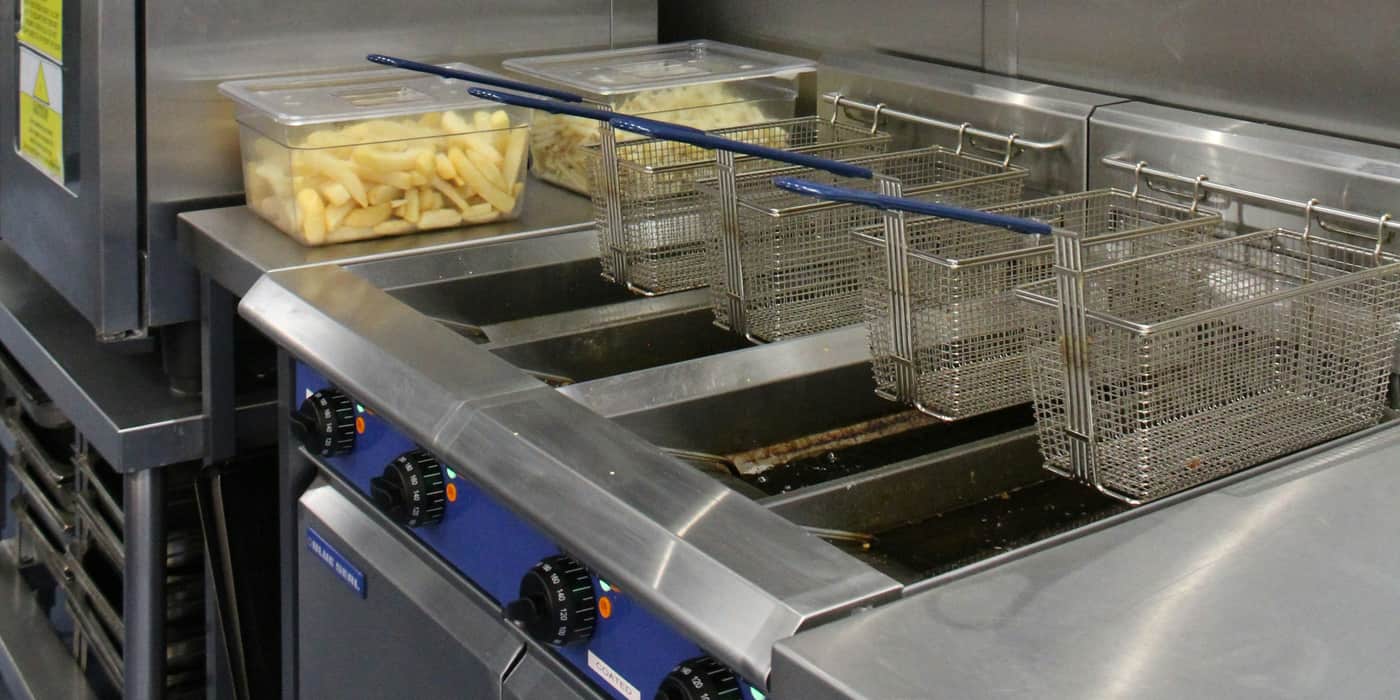
A fryer that will not heat or recover is usually waiting on a failed temperature probe or thermostat, a tripped high-limit, a pilot or ignition fault on a gas unit, or a bad element or contactor on an electric one. Sludge and carbon on the heat surface also slow recovery. A technician tests each in order.
- Commercial Griddle Repair
A griddle with cold spots usually has a burner section that is clogged or not firing, a thermostat that is out of calibration, or a plate that has warped and lifted off the heat. On electric models, a dead element or loose connection leaves a cold strip. A technician finds which one by testing section by section.
- Charbroiler & Salamander Repair
An uneven charbroiler usually has a blocked burner or venturi tube, a collapsed or cracked radiant, or a pilot that is weak. Flare-ups come from grease built up on the radiants and in the pan below. A technician tests each burner, clears the airflow and replaces failed radiants.
- Commercial Steamer Repair
A steamer that will not make steam is usually a scale problem or a water problem: probes coated in mineral deposits misread the water level, a fill solenoid is stuck, or a heating element has failed. A door that does not seal or latch can also stop the cycle. A technician tests the water and heat path in order.
- Steam Kettle & Tilt Skillet Repair
A kettle that heats slowly usually has a heat-source problem or a jacket problem. On a self-contained unit that means a weak element, a failed contactor or a gas ignition fault. On a direct-steam unit it is often a failed steam trap or a plugged strainer holding condensate in the jacket.
- Commercial Microwave Repair
A commercial microwave that runs but does not heat usually has a fault in the high-voltage chain: magnetron, transformer, capacitor or diode. The fan, light and stirrer still work because they are on a separate low-power path from the heating circuit. That circuit stores dangerous voltage even when unplugged, so it needs a technician.
- Food Warmer & Steam Table Repair
A food warmer that does not hold food hot enough usually has a failed element, a thermostat or control that has drifted, a bad door gasket, or a dry well in a steam table where the water has boiled off. Hot holding is a safety limit: the FDA Food Code sets hot-held food at 135°F or above.
- Bakery Equipment Repair
A proofer that will not hold heat and humidity usually has a dead heating element, a drifted thermostat, a humidistat that no longer reads correctly, or a steam or water system that is scaled, empty or not delivering moisture. A proofer needs warmth and moisture at once, or the dough does not rise on schedule.
Warewashing 3
- Commercial Dishwasher Repair
Dirty or unsanitized dishes usually trace to low wash or final rinse temperature, a clogged wash arm or scrap tray, weak rinse pressure, or an empty chemical feed. A technician checks the tank and rinse temperatures against the machine's data plate, then the pump, nozzles and chemical injection in that order.
- Glasswasher Repair
Cloudy glasses usually mean mineral scale from hard water or too much rinse aid or detergent. Wet glasses after the cycle point to low rinse temperature or a rinse-aid pump that has stopped feeding. A technician descales the machine, checks the water supply and tests each chemical feed to find which it is.
- Commercial Garbage Disposal Repair
A humming disposal that does not turn is jammed or has a motor that cannot start. Bones, utensils, labels and fibrous scraps lodge between the shredder ring and the impellers, and a seized shaft or failed start component produces the same sound. Turn it off at the control, and call a technician to free it safely.
Hoods and ventilation 1
- Kitchen Hood & Ventilation Service
A kitchen hood that is not pulling smoke out usually has an airflow problem. The exhaust fan may be slipping on a worn belt or turning the wrong way, the filters or duct may be loaded with grease, or the make-up air unit may be off, leaving the kitchen too starved for replacement air for the fan to pull properly.
Food prep 2
- Commercial Mixer Repair
A mixer that hums without turning has a failed start component or a jammed gear train. One that bogs down under dough has a slipping belt, a worn clutch, a weak motor or a dry transmission. A technician checks the bowl guard interlock, the drive and the grease before tearing into the gearbox.
- Meat Slicer Repair
Uneven or torn slices come from a dull or damaged blade, a gauge plate that no longer sits parallel to the blade, a worn carriage, or a loose blade hub. A technician checks the blade edge, the gauge plate setting and the carriage travel before replacing anything.
Beverage and frozen 3
- Commercial Coffee Brewer Repair
Weak or lukewarm coffee usually traces to a scaled hot water tank, a failed tank heater or thermostat, a clogged sprayhead, or a worn inlet valve that shorts the water volume. Brew water should land on the grounds around 195 to 205°F. A technician measures temperature and volume at the sprayhead before replacing anything.
- Espresso Machine Repair
Low pressure at the group usually means a worn or weakened pump, a clogged water filter or inlet strainer, an over-pressure valve stuck open, or a blocked group solenoid. Espresso is normally pulled near 9 bar at the group. A technician measures pressure at the portafilter before touching any part.
- Soft Serve & Frozen Beverage Machine Repair
Runny soft serve usually comes from a worn scraper blade or beater that no longer pulls product off the cylinder wall, a failing compressor or low refrigerant charge, a dirty condenser, or a mix level too low in the hopper. A technician checks cylinder temperature, motor load and condenser airflow first.
Maintenance and cleaning 6
Scheduled cleaning, descaling and checks that keep ice machines, walk-ins and dish machines from failing on a Saturday night.
- Ice Machine Cleaning & Sanitizing
A commercial ice machine's cleaning interval comes from the manufacturer's manual for your model. Many manufacturers call for a full descale and sanitize at least twice a year, and busy or hard-water sites may need it more often. Slimy surfaces, cloudy ice or off tastes mean the machine is overdue regardless of the calendar.
- Ice Machine Maintenance
A maintenance visit covers the condenser coil and air filter, the water filter and inlet water system, drain and bin gasket checks, and electrical and refrigeration readings. The technician reads harvest and freeze cycle times and ice thickness and compares them with the machine's specifications.
- Walk-In Cooler & Freezer Maintenance
A walk-in maintenance visit cleans the condenser, inspects the evaporator coil and drain, tests the defrost cycle, checks door gaskets and heater wire, and measures fan motors, amp draw and refrigerant-side readings. The goal is to catch the part that is weakening before the box rises above 41°F with product inside.
- Commercial Refrigeration Maintenance
A reach-in or prep table condenser needs cleaning as often as grease, flour dust and heat load it: a unit beside a fryer or a bakery oven can need it far more often than a bar cooler in a clean room, and the manufacturer's manual sets the minimum for your model. Gaskets and drains are checked on every visit.
- Commercial Dishwasher Maintenance & Deliming
Deliming dissolves mineral scale from the heating elements, wash and rinse arms, jets, tank walls and booster heater. Scale insulates heating elements, narrows jets and slows the rinse, so the machine takes longer to heat and cleans less. A maintenance visit removes it and then confirms the final rinse temperature at the manifold.
- Fryer, Oven & Range Maintenance
A cooking-line visit calibrates thermostats against a reference thermometer, cleans burners and pilots, inspects door gaskets, hinges and fan motors, and tests safety controls such as high-limits and flame sensors. The goal is food that cooks at the temperature the dial says and equipment that does not drift into a shutdown mid-service.
Programs 2
- Restaurant Equipment Preventive Maintenance
A maintenance visit cleans and inspects the parts that wear out or clog: condenser coils, door gaskets, drains, ice machine water systems, dish machine spray arms and heaters, burners, fan motors and electrical connections. The goal is to find a failing part while it can still be replaced on your schedule.
- Emergency Restaurant Equipment Repair
When equipment fails during service, protect the food first: keep walk-in doors shut, move high-risk product to working cold storage and probe-check temperatures. Then check the breaker, write down any fault code and call. We answer emergency calls 24 hours a day, 7 days a week, and give you a written price before a repair starts.