
Commercial dishwasher maintenance and deliming in the Twin Cities
Commercial dishwasher maintenance and deliming in Minneapolis and St. Paul: scale removed, chemical feed and rinse temperature verified.
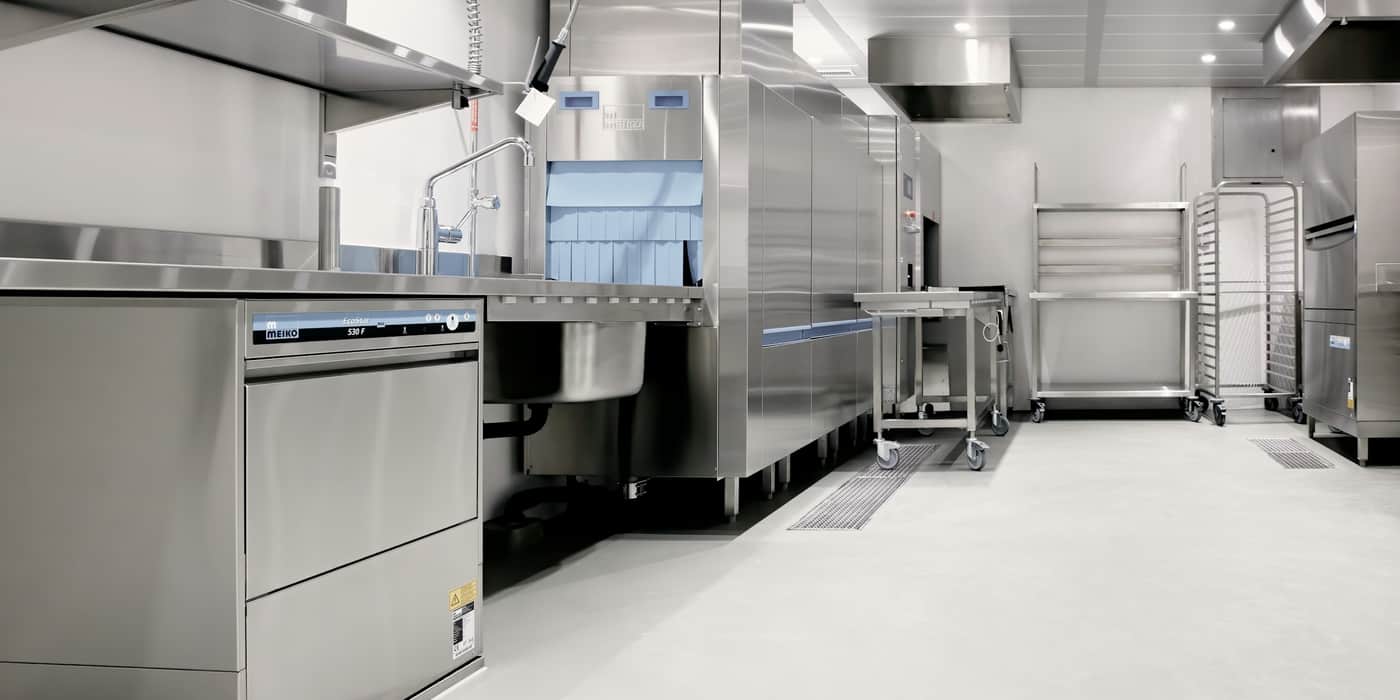
What does deliming a commercial dishwasher do?
Deliming dissolves mineral scale from the heating elements, wash and rinse arms, jets, tank walls and booster heater. Scale insulates heating elements, narrows jets and slows the rinse, so the machine takes longer to heat and cleans less. A maintenance visit removes it and then confirms the final rinse temperature at the manifold.
What a commercial dishwasher visit involves
Hard water leaves a hard crust. Every cycle, a dish machine fills with water that holds dissolved calcium and magnesium, heats it, and drops that mineral onto the first hot surface it finds, which is the heating element. The element still glows but transfers heat poorly, and the machine reads cold at the gauge. The same scale narrows the spray jets and clogs rinse nozzles. This page describes the scheduled visit that removes it; if the machine is already failing sanitizer checks, commercial dishwasher repair is the page for that.
Deliming is one part of the visit. We also check the chemical feed, the final rinse, the curtains, the drain and the booster. Worn parts are listed by name so you can see what each one does. The bar machine scales the same way, and glasswasher repair covers it when the glass line is already failing. Expect us to ask which detergent, rinse aid and sanitizer you use, since the right deliming procedure depends on the machine and its chemistry.
What the visit finds and what we do about it
| Finding | Why it develops | What is done |
|---|---|---|
| White crust on the heating element or tank walls | Calcium carbonate from hard water bakes onto surfaces as the water heats. | Delime with an approved acid cleaner at the machine's recommended concentration, then rinse the tank thoroughly. |
| Wash arm sprays unevenly | Mineral buildup or food particles block the jets, so some dishes receive no spray. | Remove the arms, clear each jet and end cap, and reinstall them so they spin freely. |
| Machine takes longer to heat the tank | A scaled element passes heat to the water slowly and runs longer to reach setpoint. | Delime the element, and test it for current draw against its rating. |
| Final rinse is cooler than the data plate calls for | A scaled booster element, a failing rinse thermostat or a restriction in the rinse line. | We check the booster, clean the rinse line and confirm the gauge matches the temperature at the manifold. |
| Film or spots on glasses | Low rinse-aid feed, an undersized rinse flow or mineral content that rinse aid cannot overcome. | Check the rinse aid pump and tubing, and adjust the feed. |
| Detergent feed is weak or none | Peristaltic pump tubing wears flat, the pickup tube clogs or the container runs dry. | Replace the pump tube, clear the pickup and set the feed against a conductivity or titration test. |
| Fill or rinse solenoid dripping | Grit or scale holds the valve seat open, so the tank keeps topping up, diluting detergent and wasting hot water down the overflow. | Replace the valve or rebuild the seat, and install or clean the inlet screen. |
| Door or curtains torn | Heat and sanitizer harden the plastic, and torn curtains let spray and steam escape. | Replace the curtains and check the door seal. |
| Tank will not drain cleanly | Scrap screens and drain stoppers are caked with food, or the drain line has a restriction. | Clean the screens and drain lines and verify the drain valve seats and opens. |
Before the visit
- Empty and rinse the scrap trays and the strainer baskets at the end of every shift, and look at what stays behind.
- Read the wash and rinse gauges during a cycle. Write down what they say so we can compare them with the data plate.
- Check the detergent, rinse aid and sanitizer containers are not empty and the pickup tubes sit on the bottom.
- Use test strips for chemical-sanitizing machines and note the result in a log.
- Look at the wash arms with the machine off and drained: if you can see crust or a blocked jet, tell us.
Stop at gas valves, 208, 240 or 480 volt wiring, sealed refrigerant circuits, steam under pressure and anything live. Those are a call.
How a commercial dishwasher visit runs
Read the machine in operation
We run a cycle and read wash and rinse gauges, the booster and the tank fill, then compare them with the data plate.
Drain and inspect the tank
With the machine off and locked out, we examine the elements, thermostats, scrap screens and arms for scale and damage.
Delime
An acid deliming cleaner is circulated through the tank and rinse system per the manufacturer's directions, never mixed with chlorine products, then the machine is flushed.
Test the chemical feed
We check each pump, tube and injection fitting and verify detergent and rinse aid are fed at the right strength.
Verify temperatures and rinse pressure
Final rinse temperature is measured at the manifold, and rinse pressure is read where a gauge is provided and held to the data-plate range, which Minn. Rules 4626.0800 limits to no less than 5 and no more than 30 psi.
Report in writing
A written list identifies worn parts and the work needed, with a price to approve before any repair.
Parts replaced on commercial dishwashers
- Wash tank heating element
- Scale insulates it and burns it out, and the machine loses wash temperature.
- Booster heater element
- Raises incoming water to the final rinse temperature; scale cuts its output.
- Peristaltic pump tubing
- A wear item in detergent, rinse aid and sanitizer feeds, and it flattens over time.
- Fill and rinse solenoid valves
- Debris or scale keeps the seat open and wastes hot water.
- Wash arm end caps and jets
- Cracked or missing caps change the spray pattern and reduce cleaning.
- Curtains and door seals
- Keep spray and steam inside the machine and protect the staff.
- Rinse nozzles and vacuum breaker
- Scale narrows the nozzles and a stuck breaker can leak water from the top of the machine.
- Thermostat and gauge sensor
- A drifting sensor gives a false temperature reading that hides a real problem.
What a commercial dishwasher visit covers
- Undercounter dishwasher
A small tank and a wash arm that sits close to the door; scale shows quickly and the machine is often on a low-temperature chemical rinse.
- Door-type (hood) dishwasher
A tank, a booster and a single rack position make the sequence simple, and the final rinse nozzles get the most scale.
- Conveyor dishmachine
Multiple wash and rinse zones mean more arms, a larger tank and a curtain system to inspect.
- High-temperature (hot-water sanitizing) machine
Relies on a booster heater to reach the final rinse temperature, so we check the booster and the thermometer.
- Low-temperature (chemical-sanitizing) machine
Relies on a sanitizer feed and test strips, so we verify the pump, tubing and concentration instead of the booster.
- Glasswashers
Small machines used at the bar that scale and film glass quickly; the same visit applies at a smaller scale.
What decides the cost
- Water hardness and how long since the last delime determine how much scale needs to be dissolved and how many cycles that takes.
- Conveyor machines with several zones take longer than undercounter models.
- Parts replaced during the visit, such as pump tubing or solenoids, are added as approved repairs.
- A machine that is difficult to reach, such as one recessed in a tight dish room, adds time.
- Whether a water softener or filter is present changes how often the machine needs the treatment.
When maintenance is not enough
Dish machines take heavy use and warm, wet air, so the frame outlasts the parts. A machine with a sound tank and frame is a good candidate for new elements, a new booster or new pumps. A tank that has pitted through, a frame with rust at the welds or a model whose rinse manifold is no longer made is a reason to price a replacement. A machine whose element and booster scale back up quickly after every delime points to a water problem a new machine would share, and the repair-or-replace guide covers the comparison.
Commercial dishwashers by brand
Related to commercial dishwasher
Repairs for this equipment
Related pages
Where it matters most
Where we service commercial dishwashers
- Commercial dishwasher service in Oakdale, MN
- Commercial dishwasher service in Plymouth, MN
- Commercial dishwasher service in Prescott, WI
- Commercial dishwasher service in Prior Lake, MN
- Commercial dishwasher service in Ramsey, MN
- Commercial dishwasher service in Red Wing, MN
- Commercial dishwasher service in Richfield, MN
- Commercial dishwasher service in River Falls, WI
- Commercial dishwasher service in Rosemount, MN
- Commercial dishwasher service in Roseville, MN
- Commercial dishwasher service in Saint Paul, MN
- Commercial dishwasher service in Savage, MN
Other maintenance and cleaning visits
Questions about commercial dishwashers
Can I use household vinegar to delime the machine?
No, household vinegar is not recommended for deliming a commercial dishwasher, because vinegar is weaker than a purpose-made deliming product and takes longer on thick scale. Most manufacturers specify an approved product and a procedure for their machine. Never mix an acid cleaner with chlorine sanitizer, because the combination releases chlorine gas.
How often should a hard-water site delime?
A hard-water site's deliming interval follows water hardness and how many racks run each day, not the calendar. Untreated hard water can put visible crust on the element far sooner than water run through a working softener. Heat-up time creeping longer and spotty glassware are the signs, and we log readings so the interval fits your water.
How do I know a machine is scaled without opening it?
A scaled dishwasher shows itself through longer heat-up times, spotty or cloudy glassware, a white film on racks and an uneven spray pattern. Looking through the door with the machine off, you may see crust on the element or the arms. The gauge reading may still look normal.
Does the machine have to be off for the whole visit?
The commercial dishwasher is out of service while it is drained, delimed and flushed, so we plan the visit for after a service period or between shifts where your schedule allows. The wash tank must be rinsed thoroughly before dishes go back in.
What should the kitchen log between maintenance visits?
Between visits, a kitchen should log the wash and rinse gauge readings during a cycle, the test strip result on chemical-sanitizing machines, and the date detergent and rinse aid containers are changed. A reading that drifts from the data plate over a few weeks tells us where to start, and it shows an inspector the machine is watched.
Can the booster scale up even when the wash tank looks clean?
Yes, a dishwasher booster can scale up even when the wash tank looks clean, because it is a separate vessel that scales where nobody looks and flushing the wash tank does not touch it. We test the booster element and thermostat on their own and measure the rinse at the manifold, since a clean-looking tank says little about the rinse side.