
CaptiveAire hood, exhaust fan and make-up air repair in the Twin Cities
CaptiveAire kitchen hood, exhaust fan and make-up air repair on site in Minneapolis, St. Paul and nearby suburbs. Fans, controls, filters and lights.
What fails most often on CaptiveAire kitchen ventilation?
On CaptiveAire systems the usual calls are rooftop exhaust fans with worn belts or bearings, grease-loaded wheels that throw the fan out of balance, make-up air units that will not start or hold their burner, and hood lights or switch panels that have quit. The hood canopy itself rarely fails; the moving parts around it do.
CaptiveAire kitchen hoods
CaptiveAire Systems started in North Carolina in the 1970s and now builds most of what sits on a kitchen ventilation job: the hood, the grease filters, the rooftop fans, the make-up air unit and the controls. It is privately held and runs plants in several states, so one kitchen in the Twin Cities can easily have a CaptiveAire hood, a CaptiveAire fan and a CaptiveAire make-up air unit all talking to the same switch panel. That is convenient when the parts match and confusing when a later remodel mixed in other makes.
You see the brand on strip-mall restaurants, school and church kitchens, and fast-casual build-outs where a single supplier handled the whole ventilation package. We repair these systems on site: fans, belts, motors, make-up air faults, filter racks, lights and control wiring under our kitchen hood and ventilation service. A common thread is that the hood, the fan and the make-up air are interlocked, so a fault in one often shows up as a complaint about another, such as a smoky line or a back door that suctions shut.
Reading the plate on CaptiveAire kitchen hood
On most CaptiveAire exhaust fans the maker's plate is on the fan housing or the motor, and a separate label sits near the hood's internal listing. Have the model, serial number, motor horsepower and voltage, and whether the fan is belt-driven ready when you call. Read the hood label from inside the canopy once the cooking line is cold and the filters are out.
CaptiveAire exhaust hoods and filters
Equipment guide
Seen on this line: Filters loaded with grease or sitting crooked in the rack / Drain cup or trough overflowing / Failed lamps, cracked lenses or water in a light fixture / Smoke rolling out of the hood edge at the line
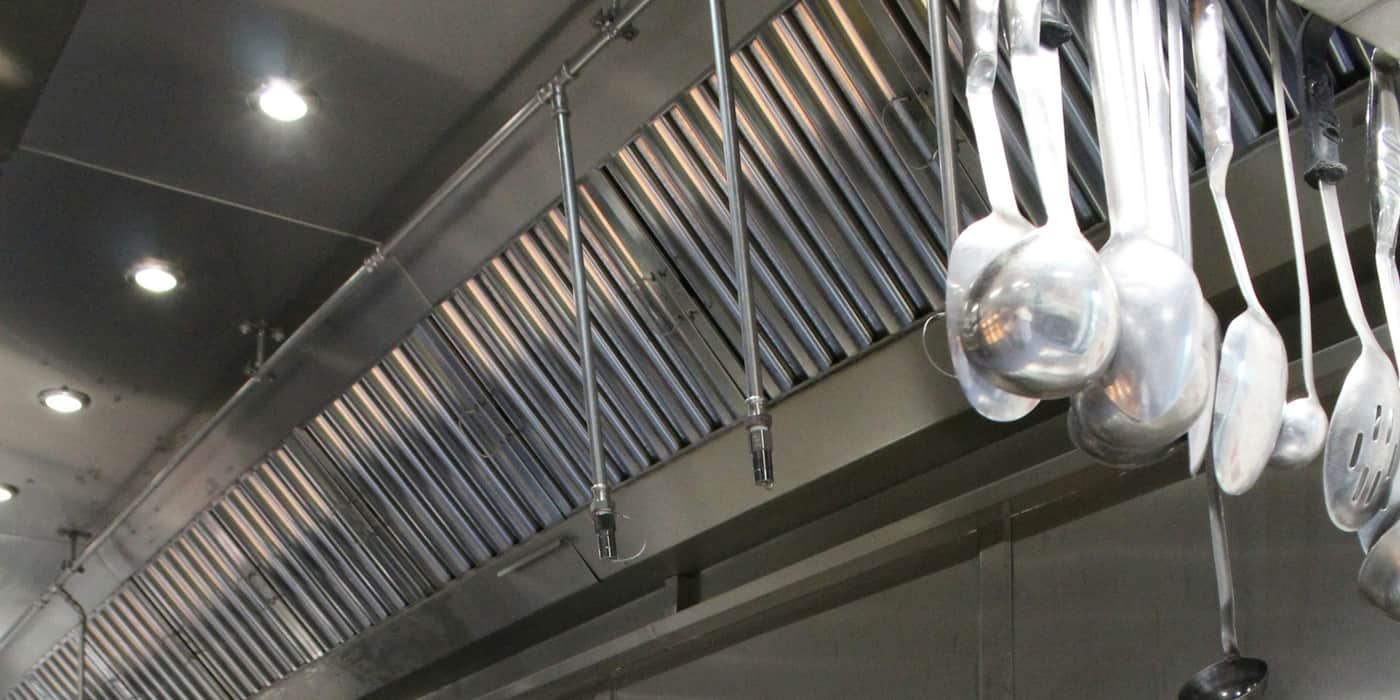
A Type I hood over a fryer line or charbroiler collects grease in baffle-style filters and drains it to a cup or trough. The failures we see are practical ones: filters left unwashed until the airflow drops, filters that no longer seat square in the rack so smoke slips past, drain cups that overflow because nobody empties them, and vapor-proof light fixtures with failed lamps or cracked lenses. The hood shell holds up for decades, but welded seams and corners that collect grease get slick and can leak onto the cook line. When a cook says the hood has stopped pulling, we check the filters and the fan before we blame the hood.
CaptiveAire rooftop exhaust fans
Equipment guide
Seen on this line: Slipping, glazed or snapped belts / Bearing noise or a loose pulley / Wheel out of balance from grease buildup / Motor tripping on overload or running hot
CaptiveAire's catalog runs from axial and centrifugal to inline and high-volume low-speed fans, and the kitchen jobs we see are mostly belt-driven upblast units on a hinged base. The hinge is the first thing we test on a roof call: it lets the fan tip back so the wheel and motor can be reached, and a seized or rusted hinge makes every other check harder. Winter adds a cold-soaked belt that slips, and grease on the wheel adds weight to one side until the whole fan shakes. We check rotation, belt tension, pulley alignment, bearing noise and motor amps, and we look for grease running past the collection cup onto the roof surface.
CaptiveAire make-up air units and controls
Equipment guide
Seen on this line: Unit will not start or drops out after starting / Dirty filters or a tripped pressure switch / Damper actuator not opening / Heating section not producing heat in winter
The brand lists filtered inline and rooftop make-up air units, economy models, and cooling and heating modules, along with switch panels, lighting control and power monitoring. A make-up air unit that will not run is often an interlock problem: a safety switch, a damper that did not prove open, a blocked filter that tripped a pressure switch, or a control board waiting on a signal from the exhaust side. When the unit has a burner, gas train work is the technician's job, not the operator's. If you smell gas, leave the roof or the building and call the gas utility from outside.
Sourcing parts for CaptiveAire kitchen hood
Fan belts, bearings, pulleys, motors and standard filters are common to the trade and can often be matched by size and rating. Control boards, make-up air burner parts, actuators and hood-specific lights or filter racks are brand-specific and may need to come from the maker's parts channel. Lead times vary by part and season, so the plate details and a description of the part help pin down what is actually on the unit.
CaptiveAire next to Halton and Gaylord
Questions about CaptiveAire equipment
Why does my CaptiveAire hood pull less than it used to?
Start with the filters, which load with grease faster than anyone expects over a busy fryer line. If they are clean, the fan belt may be slipping or the wheel may be coated, both of which cut airflow without stopping the fan. A closed damper or a failed make-up air unit starves the hood too.
Why does the roof fan shake or make a growling noise?
A shake usually means grease has built up unevenly on the wheel or a pulley has loosened. A growl points to a bearing on its way out. Shut the fan off and have it looked at before the bearing seizes and takes the motor or belt with it.
Can the make-up air unit and exhaust fan be repaired separately?
Yes, but they are interlocked, so we test them together. A make-up air unit may refuse to start because the exhaust fan has not proven, and an exhaust fan may be held off by a switch panel fault. Fixing one half and leaving the other can send you back to the same complaint.
Does CaptiveAire also make fire suppression?
The maker lists fire suppression among its kitchen ventilation products, but suppression inspection, recharge and repair belong to a fire protection company, not to us. If a fault involves the suppression system or its fuel shutoff, we point you to that trade.
Why does the back door suck shut when the hood runs?
That is a make-up air problem. The hood is pulling more air out than is coming back in, so the building draws it through the door. A dirty filter, stalled damper or tripped make-up air unit is the usual cause. Do not prop the door as a fix, because it hides the fault.