
Meiko commercial dishwasher repair in the Twin Cities
Meiko commercial dishwasher repair on site in Minneapolis, St. Paul and nearby suburbs for hospital, school, hotel and restaurant dish rooms.
What goes wrong with Meiko warewashers?
Meiko machines fail where any hot-water warewasher does: scaled heating elements, blocked wash jets, worn pump seals and failed rinse valves. Their electronic controls and sensors add a layer, so a display fault may be a sensor, a contactor or a sticking valve. We read the fault, then test the part before replacing it.
Meiko dishwashers
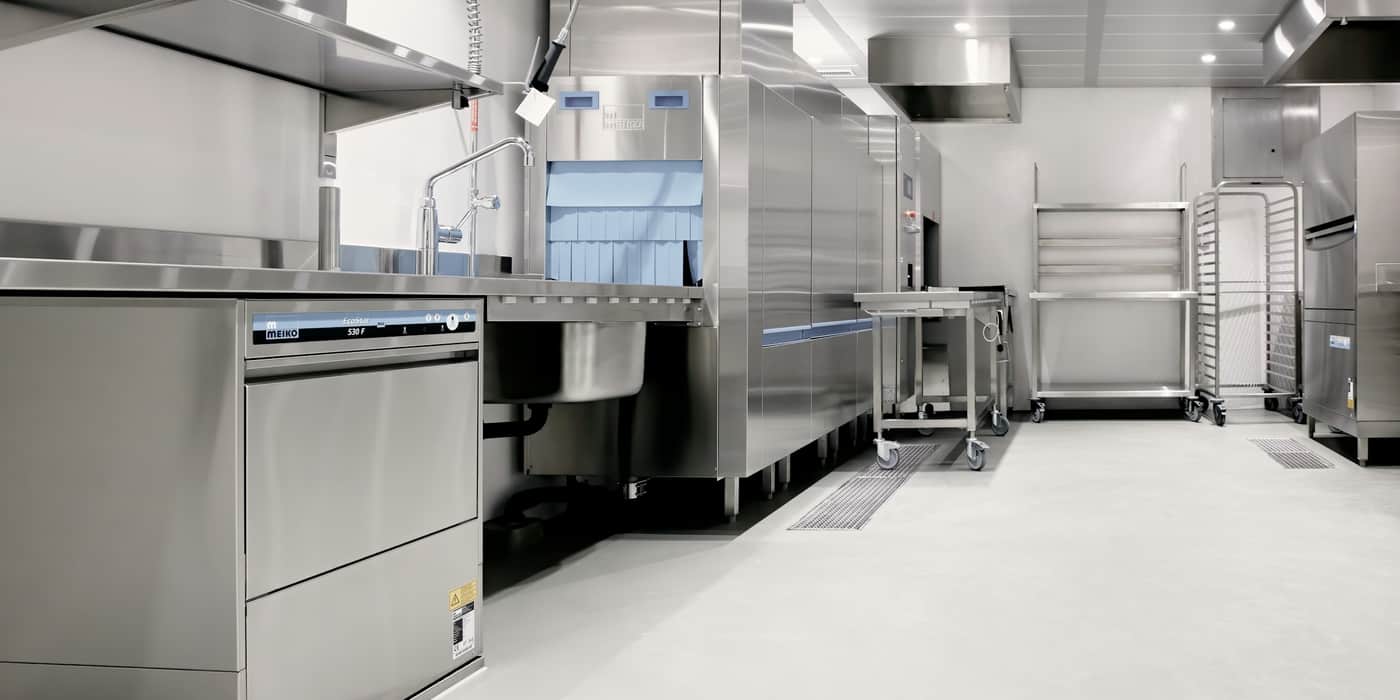
Meiko is a German warewashing manufacturer based in Offenburg, founded in 1927 and owned by a foundation rather than a corporate parent, with a U.S. subsidiary supporting North America. It makes undercounter machines, hood-type machines, rack conveyors and flight-type systems. In the Twin Cities you meet Meiko mostly in large institutional dish rooms: hospital kitchens, college dining halls, hotel back-of-house and bigger restaurants that wanted a European machine with lower water and energy use.
Servicing a Meiko means respecting the electronics. The control logic, temperature sensors and the way the machine manages its rinse and heat cycle are more integrated than on a basic American door machine, so guessing at parts costs money. A Meiko also expects stable water pressure at the machine, and low pressure alone can mimic a failed rinse valve. Our commercial dishwasher repair page explains how we diagnose, and the dishwasher not sanitizing guide shows the checks that matter when a health inspector is involved.
Reading the plate on Meiko dishwasher
Meiko puts a rating plate on the machine, usually on the side or rear panel on most models, listing the type, serial number, voltage and power. Have that ready, along with the machine's type (hood, undercounter or conveyor), whether it has heat recovery, and the exact text on the display when it faults. If the display cycles through several messages, write them down in order.
Meiko hood-type and undercounter machines
Equipment guide
Seen on this line: Hood switch not registering so the cycle will not start / Wash tank slow to heat or temperature sensor drifting / Weak rinse from scaled nozzles or a slow rinse valve
Hood-type machines are the Meiko you meet in mid-size kitchens, and undercounter units show up in cafes and care homes. Typical faults are a wash tank that does not heat, a rinse that is weak or cold, and a hood that will not register as closed so the cycle will not run. Wash pumps and their seals wear, and blocked nozzles cut the spray. The electronic control reports faults on its display, which saves time, but a displayed fault describes a symptom, not a part. We confirm with a meter before ordering anything.
Meiko rack conveyors and flight-type machines
Equipment guide
Seen on this line: Transport drive or chain wear causing racks to stall / One wash or rinse zone not heating / Torn or misplaced curtains spilling water
Large Meiko conveyors run for hours, so wear shows up in the drive and the transport. We see rack drive motors and gear units that run hot, chains and drive links that stretch, and curtains that tear or sit wrong and spill water out of the tunnel. Zone heaters and pump motors are on separate circuits, so one dead zone does not mean the whole machine is failing. On these machines a methodical test of each zone saves hours compared with swapping parts. Some units carry heat recovery or exhaust-air systems, which add sensors and fans to the checklist.
Deliming and sensor care on Meiko machines
Equipment guide
Seen on this line: Scale on temperature sensors and elements / Dosing pump out of calibration / Nozzles partially blocked so rinse volume falls
Meiko machines depend on accurate sensors and clean nozzles, so scale control matters. A scaled sensor reads temperature slowly and can make the machine run extra heat or stop early, and scaled nozzles cut rinse volume. A regular delime, a nozzle check, a look at the pump seals and a test of the chemical dosing keep the machine consistent. In a hospital or school, that consistency is what keeps the dish room passing inspection. On a hospital or school machine we also compare the displayed tank temperature with a separate thermometer, since a drifting sensor reads fine on the panel while the dishes are under-heated.
Sourcing parts for Meiko dishwasher
Meiko is a European manufacturer with a U.S. subsidiary, and many parts are specific to its machines, especially controls, sensors and pump assemblies. Common wear items like gaskets, curtains and solenoid valves are often available from compatible sources, but we match everything to the serial number and type. Because some parts ship from further away, we explain lead time in general terms before you approve the repair.
More Meiko equipment: glasswashers
Other equipment
More warewashing brands
Questions about Meiko equipment
Why does my Meiko show a fault but still seem to wash?
A fault on a Meiko display often flags a sensor or a safety circuit, not a failed wash. The machine may keep running in a limited mode while it reports the problem. We read the fault, test the sensor and its wiring, and confirm the real cause before replacing parts.
Is a Meiko harder to repair than an American machine?
A Meiko is not harder to repair than an American machine, only different. The layout and controls follow European design, so we rely on the wiring diagram and the fault display instead of assumption. The core parts (pump, element, valves, curtains) still wear in familiar ways.
Why is my Meiko conveyor tank not reaching temperature?
A Meiko conveyor tank that is not reaching temperature typically has a scaled or failed element, a contactor that is not pulling in, a temperature sensor reading wrongly or a tank that is not filling to the right level. We check the heating circuit under power to separate those.
Does heat recovery on a Meiko change how it is repaired?
Yes, heat recovery on a Meiko changes how it is repaired, because a heat-recovery or exhaust-air unit adds fans, sensors and a heat exchanger, and a fault there can trip the main machine. We look at those components during diagnosis so we do not chase a symptom in the wash section.
What should a hospital dish room do when the Meiko goes down?
When the Meiko goes down, a hospital dish room should switch to the manual three-compartment sink method its food safety plan describes, then call us. Do not run the machine if it will not reach its sanitizing temperature or chemical level. Stopping early protects trays from going out unsanitized.